What It Looks Like
Without the Oxford comma (common in British English and journalism):
“For dinner I had soup, salad and pasta.”
With the Oxford comma (standard in American academic, technical, and legal writing):
“For dinner I had soup, salad, and pasta.”
The difference is one comma, but it removes any chance of reading “salad and pasta” as a single combined dish.
Classic (and Hilarious) Examples of Ambiguity
- The book dedication
“I’d like to thank my parents, Jo Hill and God.”
→ Without the comma, the author’s parents are apparently Jo Hill and God.
“I’d like to thank my parents, Jo Hill, and God.”
→ Three separate parties. Much less blasphemous.
- The party invitation
“We invited the strippers, JFK and Stalin.”
→ JFK and Stalin are apparently the strippers.
“We invited the strippers, JFK, and Stalin.”
→ Three very different guests.
These examples are funny in everyday writing, but in legal or technical documents the stakes are dramatically higher.
A Real Million-Dollar Case
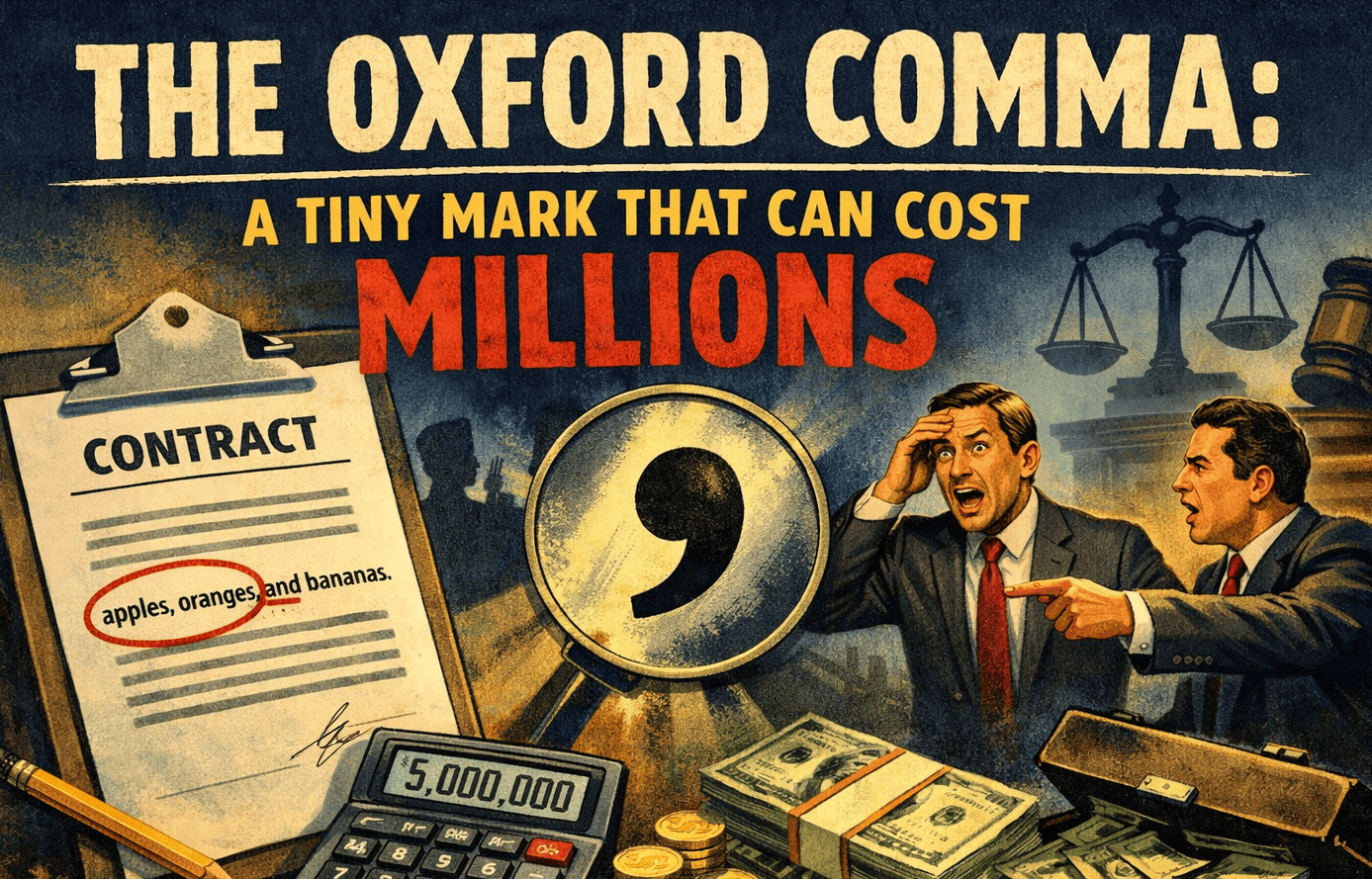
In 2017, a U.S. federal appeals court decided O’Connor v. Oakhurst Dairy, a class-action lawsuit worth approximately $10 million. The dispute turned entirely on the absence of an Oxford comma in Maine’s overtime law.
The statute exempted from overtime pay:
“The canning, processing, preserving, freezing, drying, marketing, storing, packing for shipment or distribution of agricultural produce…”
Drivers argued that “packing for shipment or distribution” was a single activity (packing something either for shipment or for distribution). The dairy argued that “distribution” was a separate exempt activity.
Because there was no comma before “or distribution,” the court ruled that the phrase was ambiguous and—under Maine’s rule that ambiguities are construed against the drafter—the drivers won. A single missing comma cost the company millions.
Had the law read “packing for shipment, or distribution,” the legislative intent would have been unmistakable.
Where the Oxford Comma Is Effectively Mandatory
- S. legal drafting (contracts, statutes, regulations)
- Patent applications and technical specifications (USPTO examiners and courts expect maximum clarity)
- Academic and scientific publishing in American English
- Style guides that prioritize clarity: Chicago Manual of Style, APA, MLA, AMA, IEEE, U.S. Government Publishing Office Style Manual
Where It Is Often Omitted
- British English (not a strict rule, but traditionally avoided)
- Journalism under AP Style or Reuters (space is at a premium)
- Casual writing and marketing copy
Practical Recommendation for Patent and Legal Writers
Use the Oxford comma consistently. The tiny amount of extra ink (or pixels) is far cheaper than years of litigation or a rejected patent claim.
Clear example in a patent claim:
“The system comprises a processor, a memory, and a display.”
Unambiguously three separate elements.
Ambiguous alternative:
“The system comprises a processor, a memory and a display.”
A court or examiner could theoretically argue that “a memory and a display” are a single combined subunit.
Final Thought
The Oxford comma is not about aesthetic preference or “correctness” in some abstract grammatical sense. In high-stakes writing—especially patents, contracts, and legislation—it is an insurance policy against expensive misinterpretation. The next time you write a list of three or more items, remember the dairy drivers in Maine. That little comma before «and» or «or» might be the most valuable mark you ever put on paper.